

Disclosure: This post contains Amazon affiliate links. As an Amazon Associate, I earn from qualifying purchases at no extra cost to you. Learn more.




View on Amazon
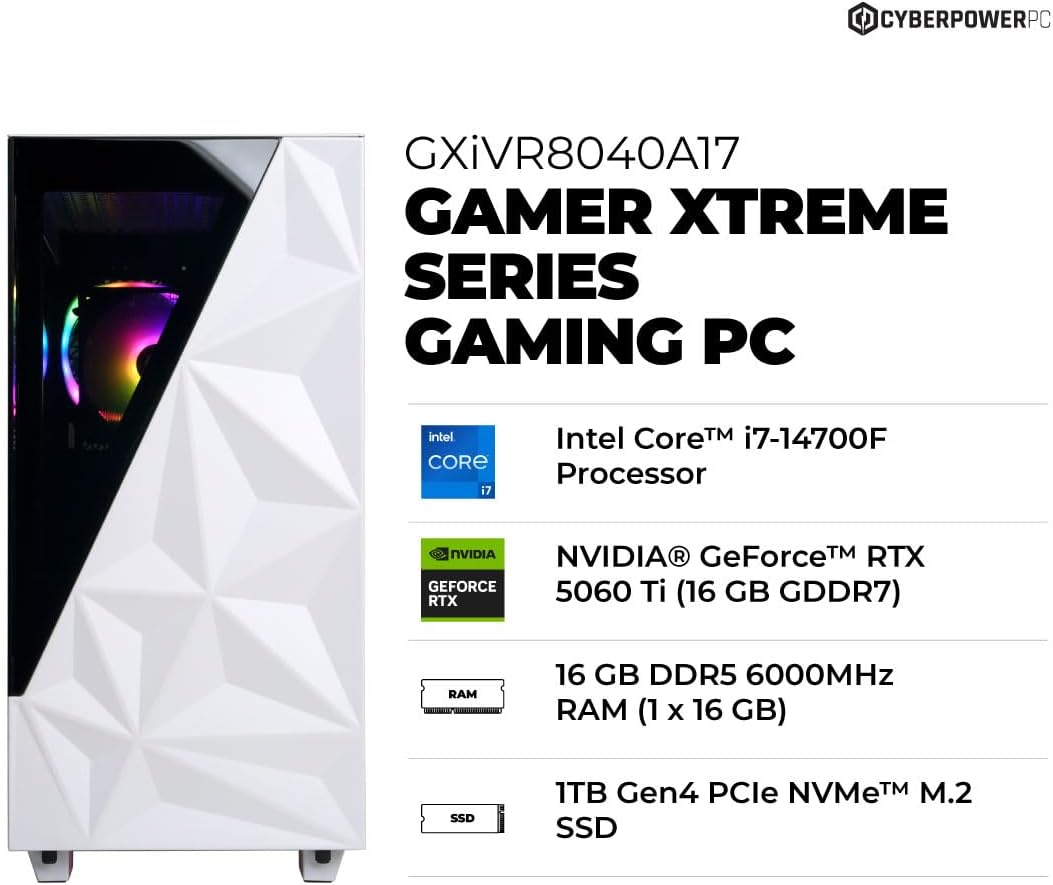
System: Intel Core i7-14700F 2.1GHz 20 Cores | Intel B760 Chipset | 16GB DDR5 6000MHz | 1TB PCIe 4.0 NVMe SSD | Windows 11 Home
Graphics: NVIDIA GeForce RTX 5060 Ti 16GB Graphics | 1x HDMI | 2x DisplayPort
Connectivity: 2 x USB-C 3.2 | 3 x USB-A 3.2 | 4 x USB-A 2.0 | 1 x LAN | WiFi 6 | Bluetooth 5.3 | 7.1 Channel Audio
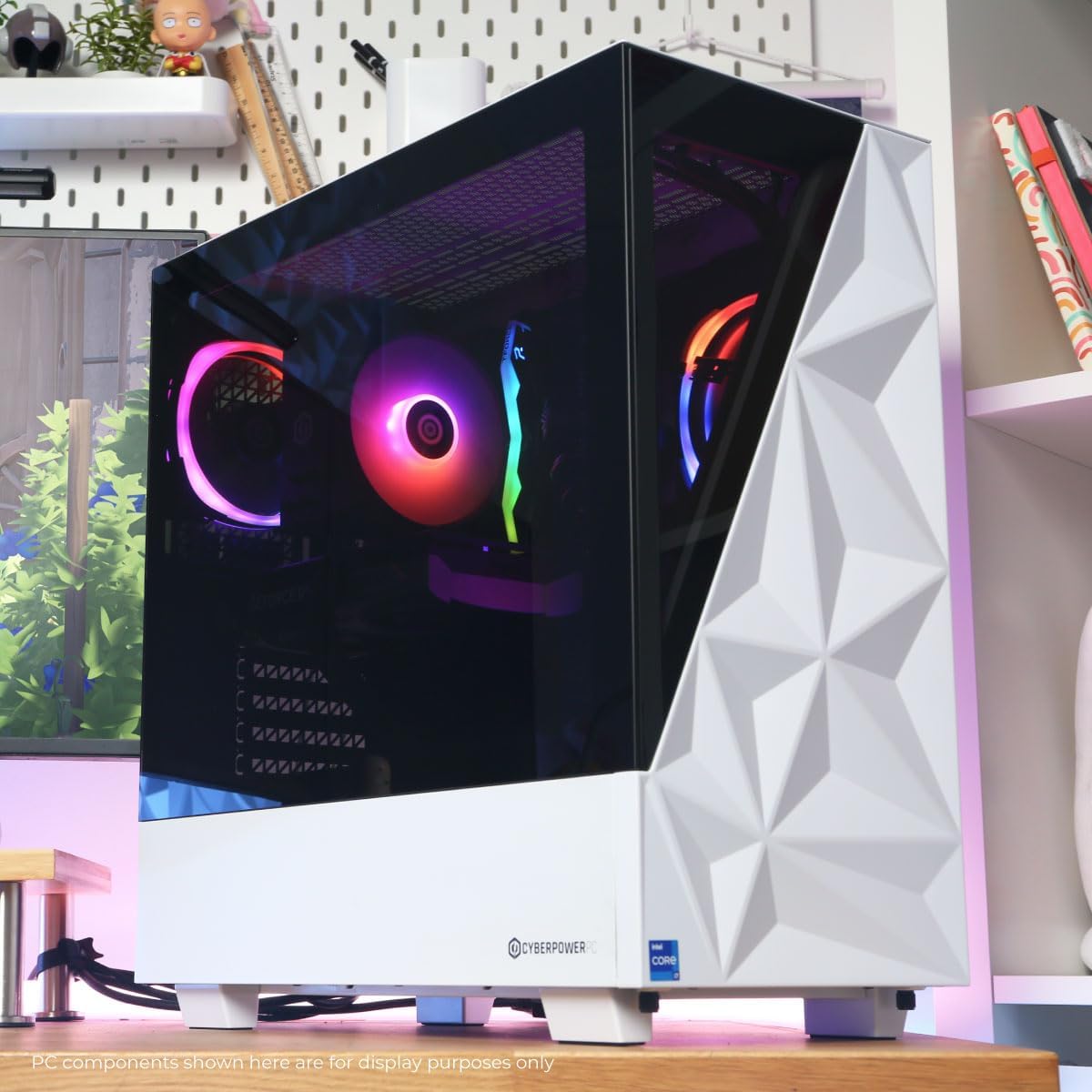
Tempered Side Case Panel | Custom RGB Lighting | Keyboard and Mouse
1 Year Parts & Labor Warranty, Free Lifetime Tech Support
CYBERPOWERPC Gamer Xtreme: A Balanced, Ready-to-Play Desktop for 1080p and 1440p Gaming
The CYBERPOWERPC Gamer Xtreme configuration shown here is built for players and creators who want a balanced, ready-to-use Windows desktop with modern parts, fast storage, and clean cable-managed airflow. At its heart sits Intel’s Core i7-14700F, a 20-core processor designed to deliver responsive desktop performance in demanding real-world scenarios: loading expansive open-world games, streaming while you play, running voice chat and overlays, or multitasking among a web browser, music player, and productivity apps. The CPU is paired with 16 GB of high-speed DDR5-6000 memory, which provides the bandwidth and latency profile that newer game engines and content-creation tools expect. Storage comes from a PCIe 4.0 NVMe SSD with 1 TB capacity, giving you quick boots, near-instant level loads in many titles, and snappy application launches even when several programs are open at once.
On the graphics side, this desktop includes a GeForce RTX 5060 Ti with 16 GB of video memory, connected to displays through one HDMI and two DisplayPort outputs. The GPU is designed for smooth play at 1080p and competitive settings, and very capable 1440p performance in many modern games when you match visual presets to your preferred frame-rate target. The 16 GB VRAM capacity provides breathing room for high-resolution texture packs and more complex scenes in supported titles, and it supports popular upscaling technologies that help you chase higher refresh rates without sacrificing visual clarity.
The motherboard platform is based on Intel’s B760 chipset, which is a proven foundation for 14th-Gen Core processors. It provides the I/O you need for a versatile modern desk setup: front and rear USB-A and USB-C for gamepads, headsets, microphones, and capture sticks; a wired LAN port for the lowest latency and the most stable downloads; and integrated Wi-Fi 6 with Bluetooth 5.3 for cable-free accessories. Combined with Windows 11 Home, you get up-to-date driver support and gaming features like Auto HDR and DirectStorage support where applicable. A tempered-glass side panel showcases the internal RGB lighting, and the included keyboard and mouse let you get started immediately if you do not already own peripherals.
Processor Capabilities and Multitasking Behavior
The Intel Core i7-14700F brings a hybrid core layout to consumer desktops, delivering a total of 20 cores configured for both single-thread responsiveness and multi-thread throughput. This design maps well to how gaming PCs are used in practice. Foreground tasks such as your running game or real-time audio chain can benefit from the high-performance cores, while background services and parallel workloads—downloads, shader compilation, streaming encoders, or asset extraction—can utilize the efficiency-oriented cores. The end result is a system that feels responsive even when you are doing several things at once. For creators, that mix translates to quicker scrubs on timelines, faster scene iteration between previews, and shorter export times compared with previous mainstream generations.
Memory, Storage, and Project Workflow
DDR5-6000 memory in a 16 GB configuration is a sensible baseline for the current PC landscape. Many contemporary games run comfortably within that footprint, and the higher DDR5 data rate helps with minimum frame times in CPU-sensitive scenes. If you plan to keep dozens of browser tabs open, manage large Photoshop documents, or use heavy plug-ins, you can plan an upgrade to 32 GB later by adding a matched kit. Storage is provided by a 1 TB NVMe SSD on a PCIe 4.0 interface. That combination delivers high IOPS for game asset streaming, reduces hitching when levels stream in content, and accelerates installs and patches. For large libraries, you can augment the primary SSD with secondary storage—either an additional NVMe drive or a 2.5-inch SATA SSD or HDD depending on your capacity and cost priorities. Organizing your workflow so that the fastest volume holds your active games and current projects while archives move to slower storage will maintain the snappy feel over time.
Graphics, Frame-Rate Targets, and Display Pairing
A GeForce RTX 5060 Ti with 16 GB VRAM positions this desktop for confident 1080p gaming with high settings in a broad range of titles and for 1440p play in many competitive or well-optimized games. The generous VRAM capacity helps with high-resolution textures and complex scenes in supported engines, while modern upscalers and frame-generation features available in select games can further boost observed fluidity. For the best experience, pair the system with a high-refresh 1080p or 1440p monitor. The included DisplayPort outputs typically support higher refresh rates on many panels, while HDMI is convenient for TVs and capture devices. If your display supports variable refresh, enable it to synchronize frames and reduce stutter during fast motion.
Cooling, Airflow, and Acoustic Profile
This Gamer Xtreme build is enclosed in a chassis with a tempered-glass side panel and open intake paths for consistent airflow over the CPU cooler and GPU cooler. Proper cable management and straight airflow from front intake to rear or top exhaust help the components maintain boost clocks during heavy gaming or content-creation sessions. RGB lighting is present but does not impede thermals when configured sensibly. For users placing the tower on carpet, a small riser or a hard mat beneath the case can improve intake clearance and dust management. Periodic dusting of front filters and fan blades will keep static pressure where it needs to be for both thermal headroom and noise control.
Connectivity and Peripherals
The rear and front I/O cover typical gaming and streaming setups. Two USB-C 3.2 ports support fast external SSDs, modern microphones, and hubs, while multiple USB-A 3.2 ports handle keyboards, mice, headsets, controllers, and capture sticks. Additional USB-A 2.0 ports remain useful for dongles that do not require high bandwidth. A 7.1-channel audio path supports analog connections for surround speaker kits, and Bluetooth 5.3 adds flexibility for wireless headsets and gamepads. For networking, many gamers still prefer a hardwired LAN connection for consistent latency in competitive titles, but integrated Wi-Fi 6 is practical for households where running a cable is not possible. If you stream or transfer large files to a NAS, consider a wired link for peak stability.
Software Foundation and Quality-of-Life Features
Windows 11 Home provides the platform for current graphics drivers, game clients, and production apps. Features such as a modern taskbar, window management, quick settings, and improved HDR handling streamline daily use. If you take advantage of virtual desktops, you can dedicate one desktop to gaming and another to productivity, keeping your workspace organized. With the included keyboard and mouse, first-time PC buyers can power on, sign in with a Microsoft account, and begin installing their favorite titles right away. Utilities for RGB lighting and fan curves typically allow you to set a quiet profile for late-night sessions and a performance profile for sustained rendering or encoding workloads.
Use Cases Beyond Gaming
While the Gamer Xtreme brand centers on play, a balanced CPU and GPU configuration is equally useful for many other tasks. Photo editors will notice snappy culling, quick brush response, and accelerated exports. Video editors working with 1080p or 1440p footage will benefit from hardware media engines and GPU-assisted effects on supported timelines. 3D artists and CAD users will find that mid-weight projects preview smoothly when working within the GPU’s resource envelope. For students and home offices, the machine doubles as a powerful productivity box that handles conferencing, document suites, and browser-based research without compromise.
Expandability and Upgrade Paths
One of the advantages of a desktop tower is the room to grow. If your library expands, you can add more NVMe or SATA storage; if your multitasking needs increase, you can upgrade to 32 GB or 64 GB of DDR5. Additional case fans can be installed to fine-tune the pressure balance or to feed a future GPU with cooler intake air. Capture cards, sound cards, and networking cards remain options if your workflow evolves. When paired with a quality power supply and a sensible thermal profile, these upgrades extend the useful life of the system and reduce total cost of ownership compared with frequent whole-system replacements.
Display and Audio Recommendations
For a balanced experience, a 24-inch or 27-inch monitor at 1080p or 1440p with a refresh rate of 144 Hz or higher will let the GPU’s strengths shine. Enable adaptive sync where available to smooth out frame pacing. On the audio side, a USB interface with a dedicated microphone can raise stream quality, while a gaming headset with good passive isolation helps you hear positional cues in competitive titles. The 7.1 analog output can drive multi-speaker setups if you prefer a living-room-style surround experience at the desk.
Network Setup and Game Library Management
If you have the option, connect the LAN port directly to your router or switch for the most stable online sessions, especially when others in the household are streaming or downloading. On Wi-Fi, placing the tower within line-of-sight of your access point and minimizing interference from thick walls will improve throughput. For game libraries, use the NVMe SSD for actively played titles to take advantage of fast level loads, and consider moving less frequently used games to a secondary drive. Game clients often allow you to set default install paths per library, making it easy to balance capacity and speed without manual file moves.
Initial Setup Checklist
- Run Windows Update and graphics driver updates before benchmarking or installing many games.
- Install motherboard chipset and audio drivers to ensure all features work as intended.
- Set your monitor to its native refresh rate in Windows display settings and in the monitor’s OSD.
- Enable XMP/EXPO or the equivalent memory profile in firmware if not already applied by the builder.
- Configure fan curves for a balance of noise and temperature that fits your environment.
- Install your preferred game launcher and set the default library to the NVMe SSD for speed.
Why This Configuration Makes Sense
This Gamer Xtreme build aims for balance: a modern multi-core CPU that remains responsive under load, memory fast enough for contemporary engines, a GPU positioned for strong 1080p and capable 1440p play with ample VRAM, and a PCIe 4.0 SSD that eliminates waiting around between matches. The connectivity mix supports both mainstream and enthusiast peripherals without immediately requiring a dock, and the case design keeps the system easy to clean and maintain. For users who want a gaming PC that feels quick on day one and has clear upgrade paths for the future, this configuration strikes a practical middle ground between cost and capability.
Specifications (As Configured)
- CPU: Intel Core i7-14700F, 20 cores
- Chipset: Intel B760
- Memory: 16 GB DDR5-6000
- Storage: 1 TB PCIe 4.0 NVMe SSD
- Graphics: NVIDIA GeForce RTX 5060 Ti 16 GB
- Outputs: 1 × HDMI, 2 × DisplayPort
- Connectivity: 2 × USB-C 3.2, 3 × USB-A 3.2, 4 × USB-A 2.0, LAN, Wi-Fi 6, Bluetooth 5.3
- Audio: 7.1-channel support
- Chassis: Tempered-glass side panel with customizable RGB lighting
- Included Peripherals: Keyboard and mouse
- OS: Windows 11 Home
- Warranty: 1-year parts and labor; lifetime tech support
Final Thoughts
The CYBERPOWERPC Gamer Xtreme presented here is a straightforward, capable desktop for players who value smooth performance at 1080p and 1440p, quick storage, and a clean, modern aesthetic. It is also a flexible workstation for everyday creativity and productivity. With thoughtful upgrades over time—more memory, additional storage, or extra case fans—it can grow with your needs while maintaining the quiet, responsive behavior that makes a PC enjoyable to use every day.